Shop-top developments command premium apartment prices

Kate Jones. | Jun 23, 2026

Shop-top developments are fetching premium apartment prices as big supermarkets take a firm foothold in the housing market. 

High-density residential projects with a major anchor, such as Woolworths or Coles, at ground level are becoming more prevalent as state governments and local planning authorities fast-track developments to ease the nation’s critical housing shortage.

The growing premium on urban convenience

Beneath the 59 apartments in the newly constructed Balfour Place in Lindfield is a full-line Coles supermarket with 250 car parks

The pulling power of Coles translated into higher apartment prices when compared to residential developments without a supermarket attached, says Luke Berry, co-founder of the developer, Third.i.

“The apartments above Balfour Place sold for 16 per cent premiums to a similar product that wasn’t above a Coles in the same LGA,” he says.

“People are willing to pay a premium to live above a Coles or a Woolworths or something that makes their life easier. And when you think about the cycle right now, the most active buyers are discerning downsizers and rightsizers, and they want convenience.

“They want to be able to hit a button, go downstairs, and buy fresh produce and a coffee and a bottle of wine, and then go back up and not have to get in the car and drive and buy their groceries. 

  • Related: How small spaces are redefining physical retail in 2026
  • Related: Revelop buys three Sydney neighbourhood shopping centres for $126m in off-market deal
  • Related: Kmart unveils K Home store as demand for large-format retail space hits supply crunch

“So there’s a massive shift towards that convenience.”
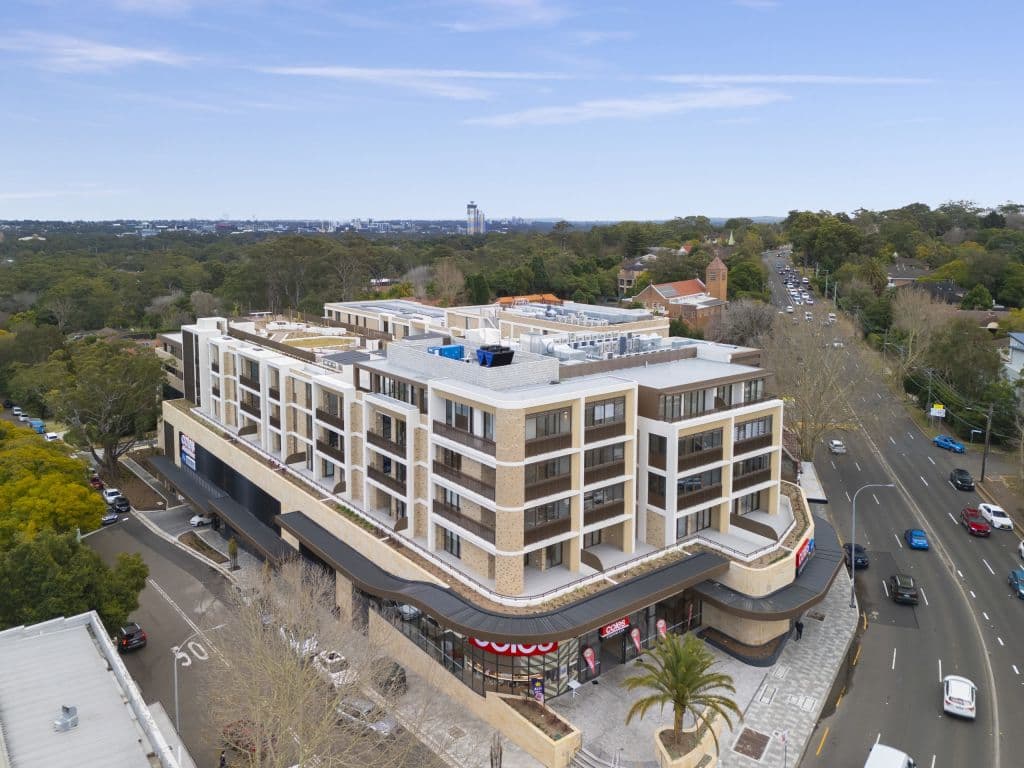
The apartments at Balfour Place in Lindfield sold for 16 per cent more than comparable apartments without a retail component.

Aligning planning policy with the 20-minute neighbourhood

The streamlining of planning applications has seen the approval of a wave of shop-top developments. 

In Melbourne, a full-line Woolworths will be located beneath a five-storey apartment building in Glen Iris by Time and Place, and Coles will be at street level in White & Weston, a 45-apartment project in Balwyn by Dimas Property Group.

In Sydney, Caringbah Pavilion by NSW Housing Corporation will comprise 188 apartments above a Coles supermarket. Like many similar shop-top projects, it is just 200 metres from a train station. 

This layering of retail and transport accessibility ticks many boxes for planning authorities and their visions of 20-minute neighbourhoods. 

“As urban populations continue to grow across the country, these types of projects ultimately mean improved convenience and amenity for these communities, and we expect to see more of these mixed-use developments in key growth areas,” says Fiona Mackenzie, Coles general manager property.

Supermarkets and residential developers often work together to ensure the project is in the right location to meet demand, she says.

“The Coles property team works hand-in-hand with the supermarket business to help secure and deliver the right sites so customers can access a Coles store where they live, work and shop,” Mackenzie says.

“We do this in different ways, depending on the site. In some cases, we lease space from third-party developers, and in others, we may acquire or develop a site.”
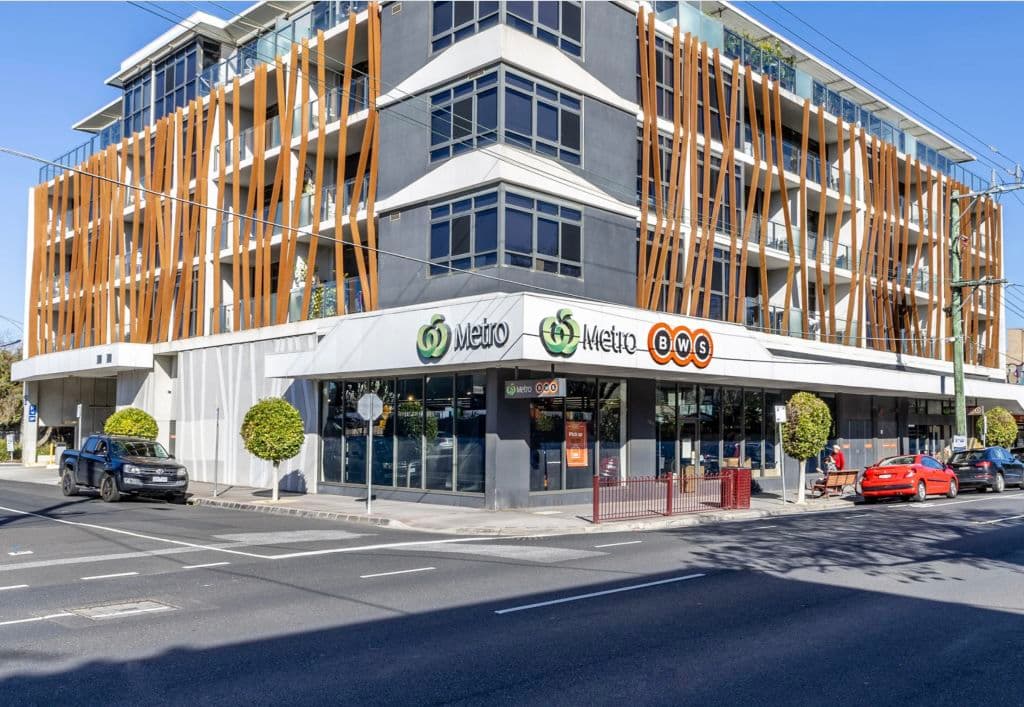
A Woolworths Metro beneath apartments in Caulfield North, Melbourne.

Overcoming community pushback through retail curation

These mixed-use developments are not always welcomed by communities, however.

In Sydney, Woolworths is battling opposition from the local council and residents of the affluent suburb of Rose Bay to its plans to build a small-format shop beneath 13 apartments. 

Woolworths’ property arm, Fabcot, declined to comment when contacted by this publication.

Diana Sarcasmo, managing director of residential at Colliers, says landlords need to get the retail curation right or risk the failure of their shop-top developments.

“I think with any new projects, there’s always going to be pushback because people are always worried about the unknown, but once they arrive, the community is the one that uses them and absolutely thrives,” she says.

“Green Square is an example of that. All the new amenities come in, the big supermarkets come in, and you see the trail of people walking from the train station via the supermarket at Green Square. They can see the benefits.”

Read more.

A Boutique Address with Lasting Perspective

At Muse Potts Point, a boutique collection of 13 residences brings a quieter, more considered approach to Sydney luxury living.

In Sydney, prestige rarely stays still for long. One decade it clusters around the harbour; the next around a newly fashionable pocket of wine bars, wellness studios and studied understatement. Potts Point has largely resisted that drift. It remains one of the city’s most self-assured neighbourhoods, where old apartment blocks, Art Deco façades and sharp contemporary hospitality sit compressed within a few tightly held streets.

That enduring appeal forms the backdrop to Muse Potts Point, a boutique collection of 13 residences taking shape on Brougham Street. Developed by Third.i in partnership with Toohey Miller, with architecture by WMK and interiors by Mathieson, the project enters a market increasingly dominated by large-scale luxury developments by taking a more restrained approach. It stays deliberately intimate.

Which also sets the tone for the project itself. At a moment when Sydney’s high-end apartment market often leans on spectacle — soaring towers, hotel-style amenities, oversized wellness programmes — Muse approaches luxury from another direction. The emphasis here is less on display than refinement: proportion, materiality, privacy and location assembled with unusual restraint.

The architecture draws carefully from Potts Point’s layered streetscape rather than attempting to overpower it. The area’s mix of historic apartment buildings and quieter contemporary interventions has long given the neighbourhood its particular texture, and Muse folds into that conversation with similar assurance. The result feels like a building designed for people who already understand the value of the postcode rather than needing to be persuaded of it.

Inside, the residences prioritise natural light, generous living spaces and tactile materials over decorative theatrics. Bespoke finishes and carefully considered detailing shape interiors that feel calm without slipping into minimalism for its own sake. There is confidence in the restraint. Nothing appears to be trying too hard.

That sensibility extends to the rooftop retreat, where expansive terraces and panoramic city and harbour views reinforce just how closely Potts Point sits to the centre of Sydney’s cultural and commercial life. Yet the appeal of the neighbourhood has always been less about proximity than atmosphere. For all its closeness to the CBD, Potts Point still functions like a neighbourhood rather than a financial district with cafés attached — walkable, dense and unusually self-contained, with restaurants, galleries, grocers and late-night familiarity compressed into a distinctly European scale.

That increasingly rare sense of urban intimacy helps explain why tightly held addresses here continue to attract downsizers, international buyers and professionals seeking a more considered version of city living. In suburbs where new development often arrives by the hundreds, Muse’s scale feels intentionally measured: 13 residences, no attempt at ubiquity, and little interest in becoming a vertical community of anonymous neighbours.

With construction now entering its final phase, prospective buyers are also able to experience the project more directly through private hard hat tours ahead of completion. That matters. Luxury apartments are often sold through renders and abstraction long before the spaces themselves can be properly understood. Walking through the evolving architecture, seeing the materials in situ and understanding the proportions firsthand introduces a level of confidence brochures rarely can.

In a city increasingly preoccupied with what comes next, Potts Point continues to offer something rarer: a neighbourhood entirely comfortable in its own identity. Muse, fittingly, appears designed with much the same assurance.

Muse Potts Point is now in its final phase of construction, with private hard hat tours available by appointment. For enquiries or to arrange a viewing, visit the Muse display suite or contact Aimee Atkins at aimee@humeresidential.com.au .

Read more.